Can Blackout Blinds Help With Shift Work Sleep Disorder?
Can blackout blinds help with shift work sleep disorder? See how blackout blinds for shift workers block daylight, what they cannot fix, and what to look for.

Quick Answer
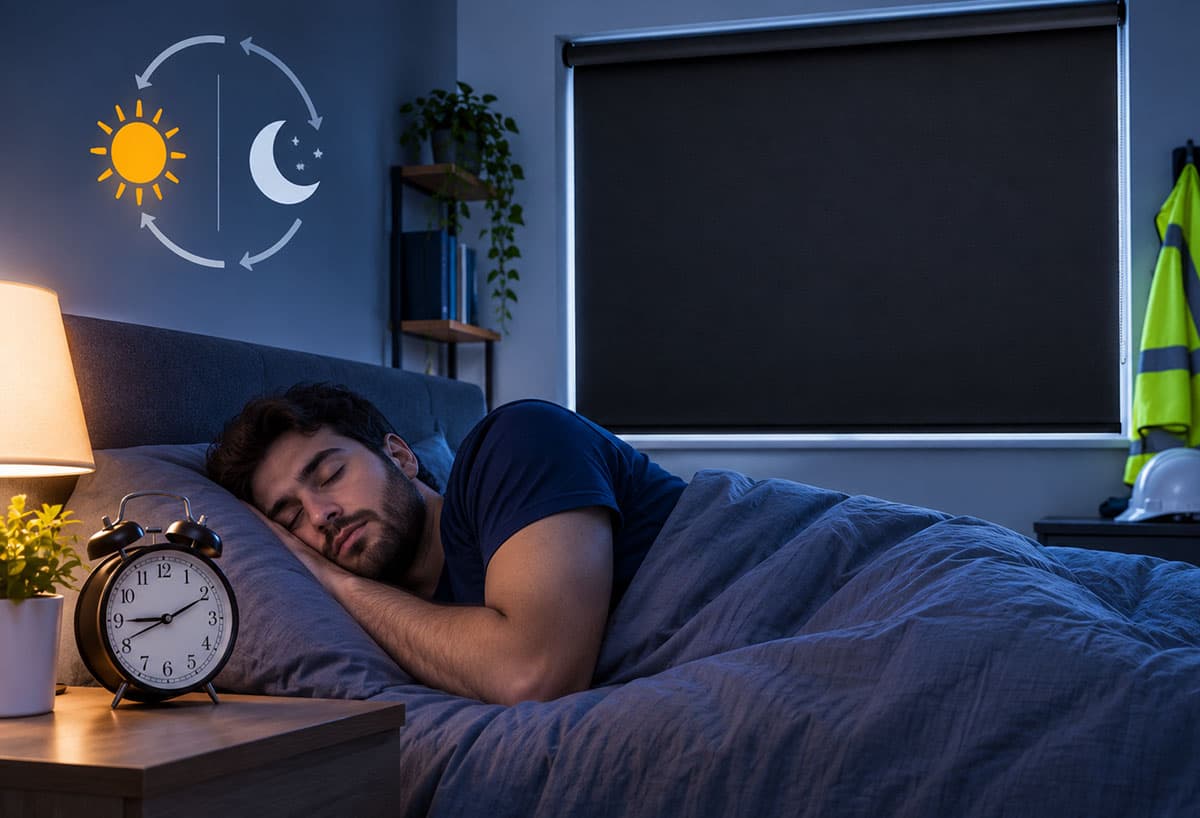
Yes, blackout blinds for shift workers can keep your bedroom dark during the day, but they solve the light problem, not a sleep disorder. Daylight is what makes a bedroom bright during the day, so blocking it is the first fix.
Choose a blind made to your exact window size, because side gaps let light creep in.
Pair it with a steady routine, a cool room, and as little noise as possible.
See a doctor if you’re still exhausted after a few weeks.
Why Daytime Sleep Falls Apart
Your body operates on an internal clock that relies on light during the day and darkness at night. Night shifts require the opposite, and the sun doesn't cooperate. Shift work sleep disorder is a circadian rhythm condition, as you can’t sleep when you want to, and you can barely keep your eyes open when you need to work. According to Cleveland Clinic, it affects roughly 10 to 40 percent of people working nontraditional shifts, and about 20 percent of the US full-time workforce does some kind of shift work.
If daytime sleep feels like a constant struggle, you’re not alone. Data from the CDC and NIOSH found that 18.5 percent of night-shift workers deal with insomnia, compared with 8.4 percent of day workers. Almost half of night workers (46.2 percent) take 30 minutes or more just to fall asleep.
Noise, heat, and an unpredictable schedule all play a part. Light, though, is the one thing you can fix in a single afternoon.
How Blackout Blinds for Shift Workers Help
Blackout blinds take away the signal that tells your brain it’s morning. If your room is very dark, your body will treat your sleep period as nighttime, making it easier to fall asleep. According to the Sleep Foundation, sunlight is one of the main hindrances to daytime sleep, and it recommends thick window covers that block all outside light.
When it comes to blackout blinds and shift work sleep disorder, it’s important to be honest about what they can do, because they change your bedroom, not your body clock. If you’re still struggling to fall asleep or stay asleep several weeks into a new schedule, or you wake up feeling exhausted after seven or eight hours in bed, talk to your doctor. Timed bright light at the start of your shift is one treatment worth asking about.
Even so, for many people, a dark room is the most important change they can make. One New York shift worker who sleeps during the day told us in a verified review that light finally stopped bleeding in from the sides once Haven was up. That small detail matters more than you’d think.
Why Most Blackout Blinds Still Leak Light
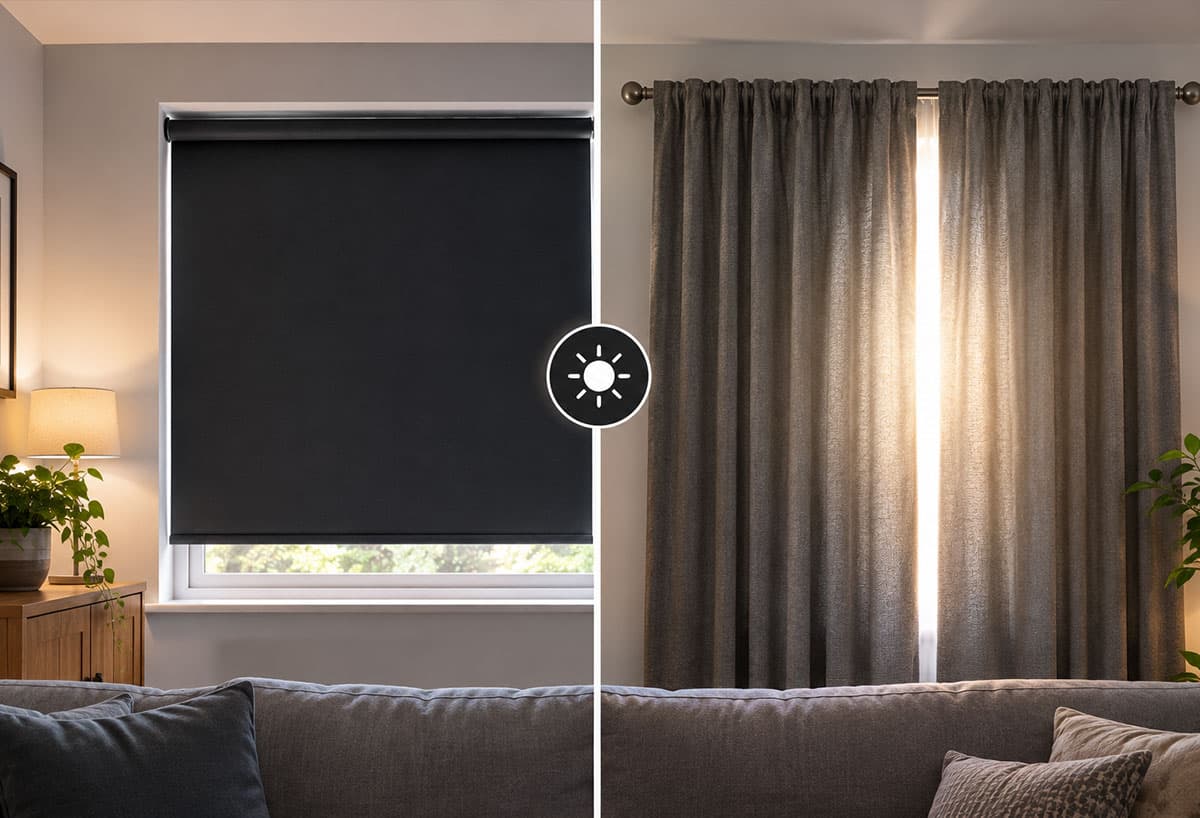
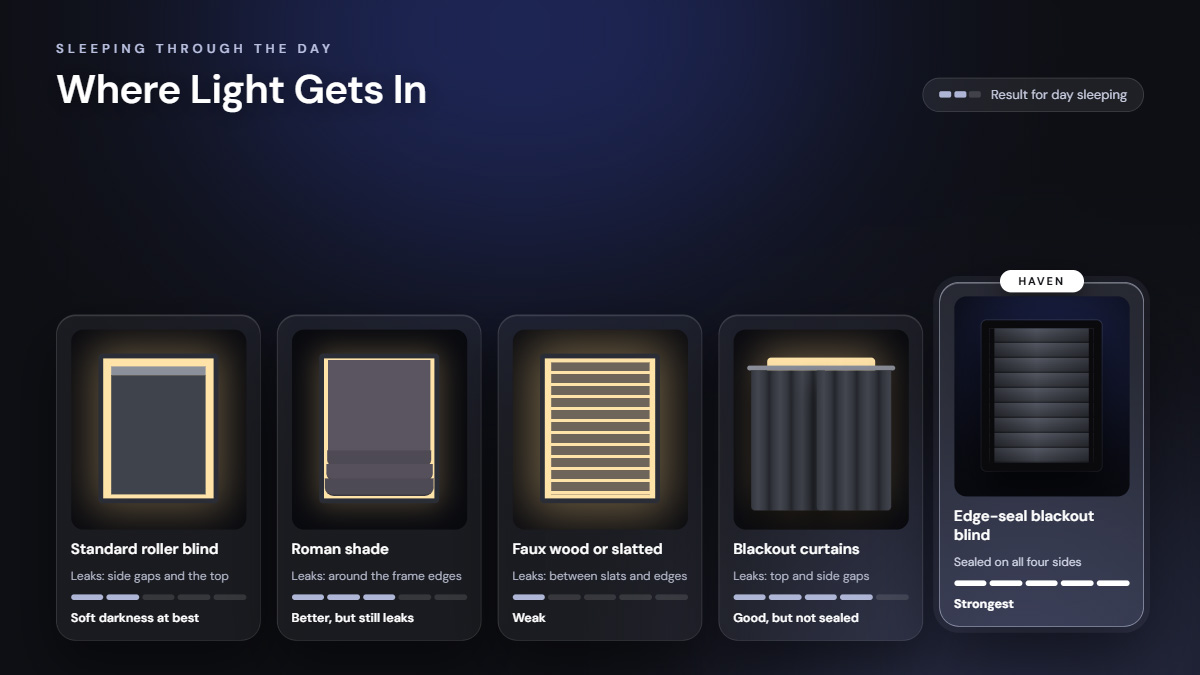
“Blackout” on a label only describes the fabric. The problem lies with the edges. A typical roller blind is installed inside the window frame, leaving gaps at the sides; in the afternoon, when it is bright outside, light leaks through those gaps. Roman blinds let light in through the sides, while slatted blinds let light in between the slats.
Option | Where light gets in | Result for day sleeping |
|---|---|---|
Standard roller blind | Side gaps and the top | Soft darkness at best |
Roman shade | Around the frame edges | Better, but still leaks |
Faux wood or slatted blind | Between slats and edges | Weak |
Blackout curtains | Top and side gaps | Good, with gaps |
Made-to-measure framed blind | Very little: made to fit the window | Strongest |
That’s why blinds made to the exact window size make the best blackout blinds for day sleepers: they leave much smaller gaps than other options.
What to Look For in Day Sleeper Blinds
The best blackout blinds for sleeping during the day have a few things in common:
A frame that fits inside the window, not just opaque fabric
Two layers of fabric, so no light passes through the material itself
A custom fit, since standard sizes almost always leave gaps
Cordless operation with enclosed hardware, so nothing rattles or tangles
Insulating fabric that helps keep afternoon heat out
A tension mount if you rent, so you don’t need to drill
Temperature is far more important than most people realize. According to Sleep.org, 65 degrees Fahrenheit (18.3 degrees Celsius) is the temperature many experts recommend as best for sleeping, and a west-facing room in the afternoon could easily be much higher. The insulating blind reduces the heat entering the room through the window.
Where Haven Fits in a Day Sleeper’s Bedroom
We designed Haven around that light-leak problem. Haven Shade uses dual-layer honeycomb fabric in an aluminum frame made to the exact size of your window, so light has very little room to get around it or through it. We make every blind to your exact width and drop, and our three-point measuring method keeps the fit flush.
If you rent or share a home, the tension mount is the part you’ll appreciate most. Haven installs in under 15 minutes with no drilling, no anchors, and no changes to your window frame, and our installation guide walks you through all six steps. One customer in Vancouver put Haven up on three windows in their apartment without drilling a single hole.
Most day sleepers need more than one window covered, and two windows plus a glass door add up quickly. That’s why our bundle offer takes 10 percent off two blinds and 15 percent off three or more while it lasts. The honeycomb layer also helps absorb sound and reduce heat transfer, addressing two other factors that interfere with daytime sleep.
Building a Better Daytime Sleep Routine
Darkness does most of the work, but a few habits can make it even more effective. Cleveland Clinic’s night shift guide suggests:
Sticking to the same wind-down routine every time, like a warm bath or a light meal
Blocking out noise with a white noise machine or earplugs and silencing your phone
Cutting off caffeine at least four hours before your shift ends
Skipping the nightcap, since alcohol disrupts REM sleep
Napping before a night shift, ideally for about 90 minutes, or 20 to 30 minutes if you’re short on time
If your sleep problems continue, talk to your doctor about other options. Blackout blinds only deal with the light.
If you work nights, night-shift blackout blinds are one of the quickest fixes you can control. Select a blind made to fit your window, measure properly, and order your Haven blind so that sleeping in the day actually feels like night. Pair it with a regular schedule, and consult your doctor if the fatigue does not stop.
FAQs
Can blackout blinds cure shift work sleep disorder?
No, they can’t. Blackout blinds can make daytime sleep easier by blocking out light, but they don’t solve the problem. If you have had symptoms for several weeks, see your doctor about changing your schedule or trying light therapy.
What are the best blackout blinds for night shift workers?
The best blackout blinds for night shift workers are custom-fit, cordless blinds made to the exact window size. Haven Shades checks every box with a made-to-measure aluminum frame and dual-layer fabric, and you can pick a color that suits your bedroom.
Do blackout blinds for day sleepers work in a rental?
Yes, they do. Haven uses a tension mount, so there’s no drilling and no changes to your window frame. Installation takes under 15 minutes, and everything you need comes in the box.
Are blackout curtains or blinds better for sleeping during the day?
Fitted blinds fit the window more closely. Curtains are mounted on a pole, allowing light to seep through the top and side edges, but a blind made to fit the window leaves far smaller gaps. When you have curtains installed already, the best combination is installing a blind behind the curtains.
How much do night shift blackout blinds cost?
Our Haven Classic starts at $129, and the flagship Haven Shade Blackout is $236. Since every blind is custom-made, your total mostly depends on window size, and the bundle discount brings down the price per blind on bigger orders.
Subscribe to our Newsletter
Stay updated with sleep guides, bedroom decor inspiration, and exclusive product news.
Nick
Contributing writer and editor specializing in light control, bedroom aesthetics, and modern sleep science.