
Outdoor Blackout Shade: What It Is, How It Works, and When You Need One
Outdoor blackout shades block sun, heat, and prying eyes on patios, porches, and sunrooms — but they solve a different problem than indoor blackout blinds. Here's how to tell which one your space actually needs.

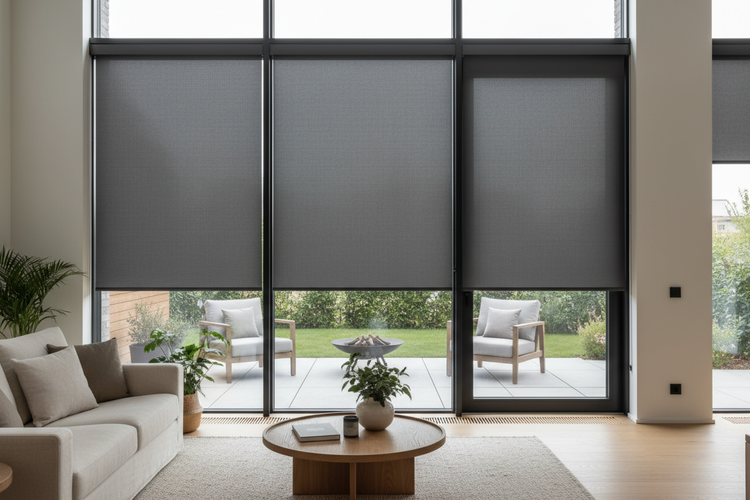
Quick answer: An outdoor blackout shade is a heavy-duty, UV-treated fabric shade mounted outside — on a patio, pergola, porch, or sunroom exterior — that blocks sunlight, heat, and glare before it hits the glass. It differs from an indoor blackout blind, which seals light inside a room and is built for sleep, privacy, and interior climate control rather than weather exposure.
Both solve real problems. Knowing which one applies to your window, door, or outdoor living space saves you from buying the wrong product.
What Makes a Shade "Outdoor Blackout"
Outdoor blackout shades are built from weather-rated fabrics — usually vinyl-coated polyester or PVC mesh with a tight weave — designed to withstand direct sun, rain, and temperature swings without cracking or fading. They're typically mounted on:
Patios and pergolas, to cut afternoon glare and heat
Porches and lanais, for privacy from the street or neighboring yards
Sunrooms and screened enclosures, to manage solar heat gain
The trade-off is durability over precision. Outdoor shades are engineered to survive the elements, not to create a zero-gap, 100% light seal. Wind, mounting hardware, and exterior brackets all introduce small gaps that a true blackout product can't have.
Outdoor Blackout Shade vs. Indoor Blackout Blind
This is where most buyers get confused, because "blackout" gets used loosely in both categories.
Outdoor Blackout Shade | Indoor Blackout Blind | |
|---|---|---|
Primary job | Reduce heat, glare, UV exposure | Eliminate light for sleep and privacy |
Light block | Partial to high (mesh-dependent) | Total, edge-to-edge seal |
Material | Weather-rated PVC/vinyl mesh | Dual-layer honeycomb fabric |
Mounting | Exterior brackets, cables, tracks | Interior tension-mount, no drilling |
Best for | Patios, pergolas, sunroom exteriors | Bedrooms, nurseries, media rooms, patio door interiors |
If the goal is genuinely dark sleep, a nap-friendly nursery, or a room where zero light bleed matters, an outdoor shade won't get there — mesh-woven fabrics are built to filter sun, not seal a frame. That's the specific gap custom blackout blinds are engineered for: a dual-layer honeycomb fabric paired with a track system that closes the side gaps standard blinds leave open, for 100% blackout rather than reduced glare.
Where This Matters Most: Patio Doors and Sunrooms
The category that sits right between "outdoor" and "indoor" is glass patio doors and floor-to-ceiling sunroom windows. These openings face direct outdoor exposure but are technically indoor installations — and they're where the wrong product choice shows up fastest.
An outdoor mesh shade mounted over a patio door will cut glare during the day but won't block streetlight or sunrise at 5 a.m. An indoor blackout blind mounted on the same door — like Haven's — handles that directly, since it's designed to seal the full frame rather than filter the exterior view. It's a scenario covered in more depth in our guide to choosing the right blackout window covering for your home, which walks through matching the product to the room rather than the window type alone.
How to Choose Between the Two
Ask what the shade needs to solve:
Heat and glare on an exterior living space (patio, deck, pergola) → outdoor blackout shade.
Full darkness for sleep, shift work, or a nursery → indoor blackout blind, regardless of whether the window faces a yard or a street.
A patio door or sunroom window used for both daytime living and nighttime sleep → an indoor blackout solution mounted on the interior, since it's the only setup built for a complete seal.
For the third scenario specifically, custom sizing matters more than it does outdoors, since even a small gap defeats the purpose. Haven blinds are made to exact width and drop measurements — our measuring guide walks through taking those measurements for oversized patio doors and standard windows alike, and our installation guide covers the no-drill, tool-free mount that takes under 15 minutes.
The Short Version
"Outdoor blackout shade" and "blackout blind" aren't interchangeable, even though search results often treat them that way. If you're managing sun and heat on a patio, look at a weather-rated outdoor shade. If you're trying to get a room — including one behind a patio door — fully dark, that's an indoor blackout blind's job. For the full category breakdown, our pillar guide on blackout blinds covers every option side by side for the interior option built specifically for a total light seal.
Common Questions
Do outdoor blackout shades actually block 100% of light? No. Even the densest outdoor mesh fabrics are woven to allow airflow and manage heat, so some light passes through by design. For a full light seal, blackout blinds for windows with an edge-seal track are the appropriate product, not an outdoor shade.
Can I use an indoor blackout blind on a patio door? Yes, when it's mounted on the interior side of the glass. Haven's tension-mount system works on standard patio doors and floor-to-ceiling windows the same way it works on bedroom windows, since it seals against the interior frame rather than the exterior elements.
What's the difference between a blackout shade and a blackout blind? The terms are often used interchangeably, but "shade" typically refers to fabric that rolls or folds (roller, cellular, Roman styles), while "blind" more often describes slatted or panel-based coverings. For a full breakdown of the category, see our types of blackout blinds guide.
Are outdoor blackout shades worth it if I already have indoor blinds? They serve different rooms. Outdoor shades protect the living space itself — reducing patio surface heat and furniture fading — while indoor blackout blinds protect what happens inside, like sleep quality and privacy. Many homes use both.
Subscribe to our Newsletter
Stay updated with sleep guides, bedroom decor inspiration, and exclusive product news.
Connor Mackenzie
Contributing writer and editor specializing in light control, bedroom aesthetics, and modern sleep science.


