
Sliding Blackout Blinds for Patio & Sliding Glass Doors
Sliding blackout blinds are window coverings designed specifically for wide openings such as patio doors, sliding glass doors, and large windows. Instead of moving vertically like conventional roller blinds, many options move horizontally along a track.

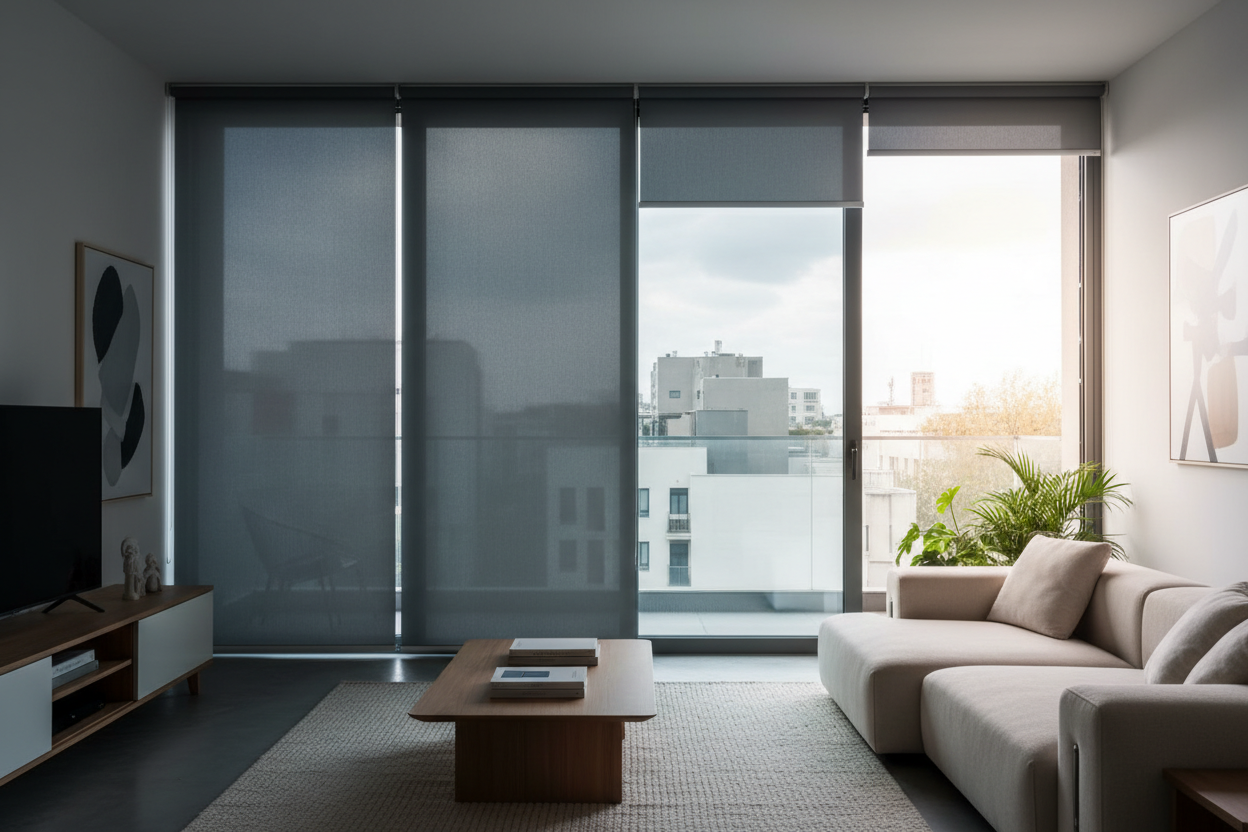
Table of Contents
What Are Sliding Blackout Blinds?
Best Blackout Options for Sliding Glass Doors
Panel Track vs. Vertical Blackout Blinds
Can Sliding Blackout Blinds Completely Block Light?
What to Consider Before Buying
How to Measure a Sliding Glass Door
Are Sliding Blackout Blinds Easy to Operate?
Conclusion
FAQs
Large glass doors can make any room appear brighter and larger, but natural sunlight may not always be welcome. Direct sunlight may cause glare, compromise privacy, increase heat levels, and make it harder to keep rooms dim when needed.
Sliding blackout blinds can make an important contribution. Unlike standard window blinds, patio and sliding glass door coverings accommodate much larger openings while still permitting easy access.
Finding the appropriate blackout coverings for large glass openings requires considering several elements, such as performance, panel design, available space, daily operation, and how the treatment fits around it. Here is what to keep in mind before purchasing such blackout treatments for large openings.
What Are Sliding Blackout Blinds?
Sliding blackout blinds are window coverings designed specifically for wide openings such as patio doors, sliding glass doors, and large windows. Instead of moving vertically like conventional roller blinds, many options move horizontally along a track.
Common choices include:
Panel track blackout blinds: Wide fabric panels slide along a track and stack to one or both sides.
Vertical blackout blinds: Individual vertical vanes rotate for light control and slide sideways when the door needs to open.
Blackout curtains: Fabric panels move along a rod and can provide strong coverage.
Custom blackout systems: These can combine blackout fabric with a fitted frame or track designed around the opening.
The best option depends on whether your priority is maximum darkness, easy access, flexible light control, or a particular interior style.
Best Blackout Options for Sliding Glass Doors
There is no universal solution for every patio door. The size and layout of the opening should influence your choice.
Option | Best For | Light Control | Operation |
Panel track blinds | Wide openings | High | Horizontal sliding |
Vertical blackout blinds | Frequently used patio doors | Moderate to high | Sliding and rotating |
Blackout curtains | Flexible, decorative coverage | High | Manual sliding |
Custom blackout systems | Maximum light control | Very high | Depends on design |
Panel Track Blackout Blinds
Panel track systems utilize wide fabric sections that travel horizontally along a track, making them an excellent solution for large openings, as the panels can stack neatly to one side or split towards both.
Wide panels also create a sleeker appearance than multiple narrow vertical vanes, making them a popular choice in contemporary interiors.
Vertical Blackout Blinds
Vertical blinds feature individual vanes that can be rotated to adjust light levels and can slide sideways when access is needed to the door.
Ideal for everyday use, these systems can allow light to pass through from behind thanks to gaps between vanes or around edges, giving a traditional aesthetic feel and saving space on storage systems.
Panel Track vs. Vertical Blackout Blinds
Both options can work well for sliding doors, but their strengths are different.
Panel track blinds feature broad fabric panels, an elegant appearance, and smooth horizontal movement for effortless covering of wide openings.
Vertical blackout blinds allow more precise light control, since individual vanes can rotate. They're also convenient when the door needs to be opened frequently.
When comparing the two, consider the frequency of door usage, the space where the blind stacks, the level of darkness needed, and which one looks better with the surroundings.
Can Sliding Blackout Blinds Completely Block Light?
Blackout fabric can block light through the material, but the complete system may still allow light around the edges.
This is one of the most important points to understand when choosing blackout blinds for sliding glass doors.
Light can enter through:
Gaps between overlapping panels
Spaces along the sides
Openings above the track
Gaps beneath the covering
Areas where the treatment does not extend far enough beyond the glass
Blinds that use genuine blackout fabric without producing complete darkness.
Furthermore, mounting method matters significantly: an outside-mounted treatment may provide greater coverage around a window opening than its inward-mounted equivalent depending on design.
For rooms where maximum darkness is key, evaluating the entire system rather than judging fabric alone should be the focus. Consider frame design, panel overlaps, edge coverages, and installation, as they all can have a profound effect on how well your final results turn out.
What to Consider Before Buying
1. Size of the Opening
Sliding doors are much wider than standard windows, so their covers must be constructed to accommodate both their size and weight without becoming difficult to operate.
2. Daily Door Access
If your patio door needs to be opened repeatedly throughout the day, consider investing in a system that is easily portable yet can still stack out of sight when not needed.
3. Panel Stacking
Consider where the panels will sit when opening the door: one-way stacks may work when there is free wall space on one side, whereas split configurations might work better in cases with symmetrical openings.
4. Light Gaps
Focus not only on fabric opacity but also how well your system manages gaps around its sides, top, bottom, and between panels.
5. Interior Style
Wide fabric panels tend to create a soft, more modern aesthetic, while vertical vanes offer a classic appearance and allow for adjustable light control throughout the day.
6. Maintenance
Large coverings require more attention in terms of upkeep; as a result, consider how easily their fabric or material can be dusted and cleaned according to manufacturer care instructions.
How to Measure a Sliding Glass Door
Accurate measurements are particularly important for large doors.
Start by measuring:
Width: Measure across the opening at the top, middle, and bottom.
Height: Measure from the intended mounting point to the floor at the left, centre, and right.
Mounting depth: Check whether there is enough space for the chosen track or frame.
Hardware: Note door handles, locks, trim, and other potential obstructions.
Stacking space: Check how much wall area is available beside the door.
Do not automatically subtract or add measurements yourself; rather, be aware that any deductions may vary depending on the product being mounted inside or outside an opening.
Measure multiple points when creating custom blackout systems to account for openings that may be slightly asymmetric or out-of-square.
Are Sliding Blackout Blinds Easy to Operate?
Yes, when the system is properly matched to the door and room layout.
Panel track blinds move horizontally along a track, allowing their panels to stack away from doors as needed. Vertical systems slide sideways while their vanes can rotate to control light.
Smooth movement and an efficient stacking configuration are as essential to everyday door usage as blackout performance.
Custom systems combine blackout material with a tailor-made frame or track. Haven Shades offers such a solution, using custom measurements and an edge sealing design for light control alongside fit and installation considerations.
Conclusion
Choosing sliding blackout blinds for a patio or sliding glass door involves more than selecting fabric alone; other aspects include the size of the opening, panel design, mounting method, light gaps between panels, stacking direction, stacking gap size, and daily operation that all contribute to its success.
Panel track systems provide an ideal choice for wide openings, while vertical blackout blinds allow for flexible light control. If maximum darkness is your goal, consider choosing a system that incorporates perimeter coverage as well as material selection into its design.
Carefully consider how you will use the door daily, and select a solution that balances light control with practical functionality.
FAQs
What are sliding blackout blinds, and how do they work on large doors?
Sliding blackout blinds are coverings for large spaces like patios and sliding glass doors. These blinds may be made from wide fabrics, vertical vanes, or specialized blackout blinds systems that will slide horizontally in order to cover an open space without obstructing the door's usage.
Can sliding blackout blinds fully block light on patio doors?
They can have a good light-blocking feature; however, the effectiveness of their blackout ability will depend on the material used, installation, overlapping, and gap issues related to that space. If you design the system in a way to eliminate the perimeter gaps, then you'll get better darkness than just the material used.
What's the difference between panel track and vertical blackout blinds?
Panel track blinds are made from wide fabric panels that will slide horizontally along the track. Vertical blackout blinds consist of vanes that will rotate and slide. The first option usually looks larger and more contemporary.
Are sliding blackout blinds easy to operate daily?
Yes. Both panel track and vertical systems can provide horizontal door movement. Your choice will ultimately depend on your door usage frequency, available storage space, and how your opening has been constructed.
How do I measure my sliding glass door for blackout panels?
Measure its width across its top, middle, and bottom edges, as well as its height from the left, center, and right edges of each side panel. Also check mounting depth, door hardware trim length, and available stacking space before following specific product-related measurement instructions.
Subscribe to our Newsletter
Stay updated with sleep guides, bedroom decor inspiration, and exclusive product news.
Sarah Jenkins
Contributing writer and editor specializing in light control, bedroom aesthetics, and modern sleep science.


