
Vertical Blinds: A Practical Guide for Windows & Doors
Vertical blinds are window coverings made of individual vertical slats, or vanes, that rotate to control light and slide sideways to open or close. They are particularly well suited to large windows, sliding glass doors, patio doors, and floor-to-ceiling windows.

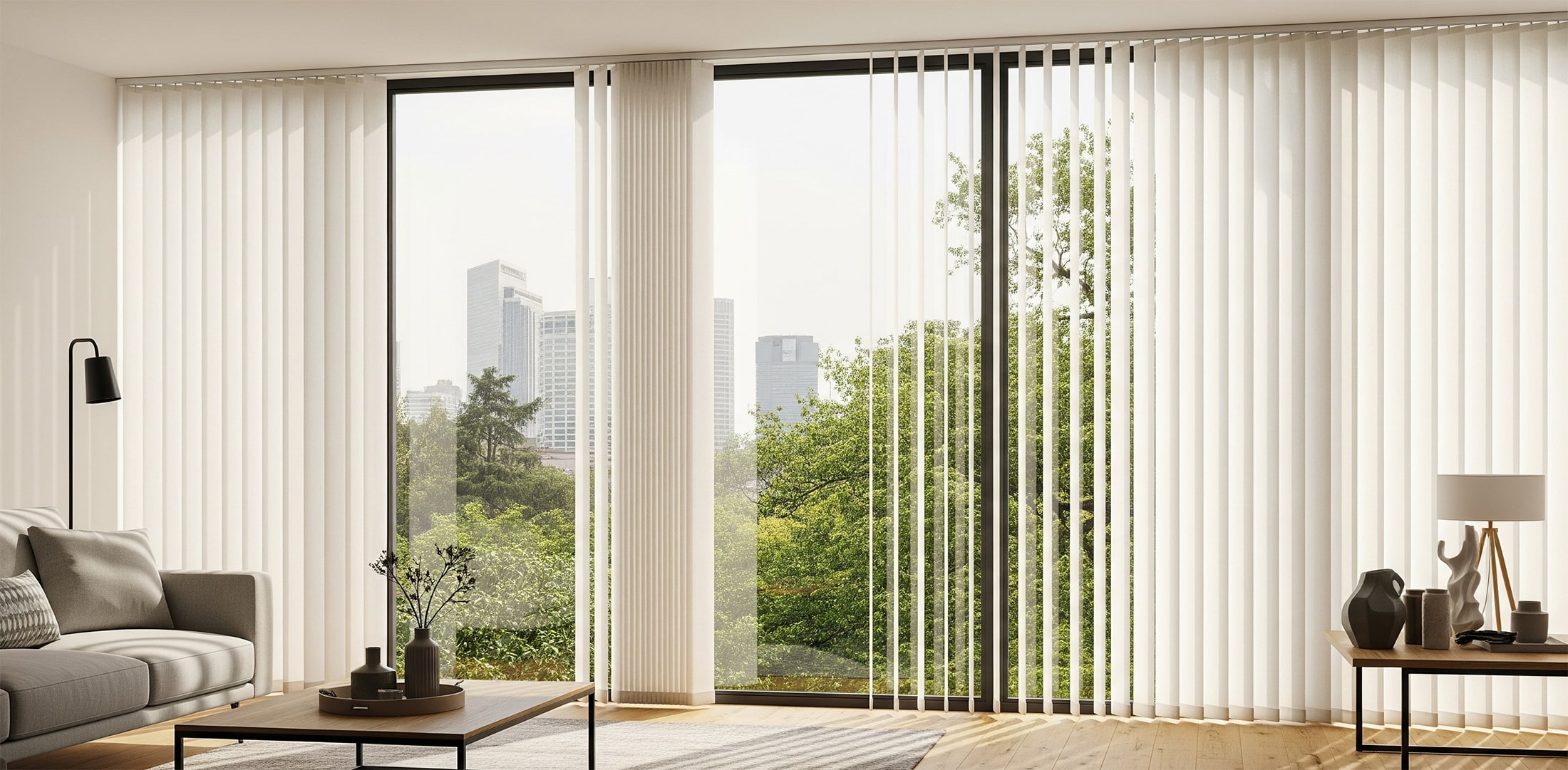
Table of Contents
What Are Vertical Blinds?
Why Choose Vertical Blinds for Windows and Sliding Doors?
Types of Vertical Blinds
How to Choose the Right Vertical Blinds
How to Clean Vertical Blinds
How to Install Vertical Blinds
Understanding Blackout Blinds
FAQs
AI Overview
Vertical blinds are window coverings made of individual vertical slats, or vanes, that rotate to control light and slide sideways to open or close. They are particularly well suited to large windows, sliding glass doors, patio doors, and floor-to-ceiling windows.
The main things to know about vertical blinds are:
Best for: Large windows, sliding doors, patio doors, and wide glass areas.
Light control: Rotating the vanes allows you to adjust how much sunlight enters the room.
Privacy: Closed vanes provide privacy while still offering flexible control over daylight.
Materials: Common options include fabric, vinyl, and PVC, with different levels of durability, softness, and light control.
Operation: They can use cords and chains, wands, or motorized controls depending on the design.
Installation: Vertical blinds can be mounted inside the window recess or outside the frame.
Maintenance: Cleaning requirements vary by material, but many options can be dusted or wiped clean.
Temperature control: Properly selected vertical blinds can help reduce direct solar heat gain and provide an additional layer between the glass and room.
Design: Available in different colours, textures, and opacity levels, they can complement both traditional and contemporary interiors.
In short, vertical blinds combine practical light and privacy control with easy side-to-side operation, making them a particularly useful choice for wide windows and doors.
What Are Vertical Blinds?
Vertical blinds are composed of individual blades, which are called vanes or louvers, and are mounted on a horizontal rod, which is called the headrail. These blades are able to pivot and rotate in order to control the amount of light entering the room. They may also slide sideways in order to open up the window or door.
Vertical window blinds are designed for large openings and therefore work well for big picture windows and sliding glass doors.
They come in various materials, colours, textures, and levels of light control. Fabric vertical blinds tend to provide a softer look, while vinyl or PVC vertical blinds are chosen for their easy maintenance.
What homeowners are asking: Are vertical blinds outdated, or can the right style still provide practical light and privacy control for large windows and sliding doors? Recent Reddit discussions show that while some homeowners dislike the dated look of older vertical blinds, others still value their easy operation and ability to balance privacy with daylight.
Why Choose Vertical Blinds for Windows and Sliding Doors?
One of the major strengths of vertical blinds for windows is their ability to cover large surfaces without making it hard for the window to function.
When it comes to sliding doors, this side-to-side mechanism becomes quite handy. The blades can either accumulate on one side or, if configured, can even open from the center.
Vertical blinds can work well for:
Wide living-room windows
Floor-to-ceiling windows
Sliding patio doors
Large bedroom windows
Home offices with expansive glazing
Open-plan spaces
Balcony or exterior access doors
For rooms where privacy matters, rotating the vanes lets you adjust the view and incoming daylight without completely opening the covering.
Vertical Blinds vs. Other Window Coverings
Feature | Vertical Blinds | Roller Blinds | Horizontal Blinds |
Wide windows | Excellent | Good | Less practical at very wide sizes |
Sliding doors | Excellent | Good | Often less convenient |
Side-to-side operation | Yes | No | No |
Light control | Adjustable | Adjustable | Adjustable |
Design options | Fabric, vinyl and more | Wide range | Wide range |
Easy access to door | Yes | Depends on configuration | Usually less convenient |
Types of Vertical Blinds
The right material depends on how you use the space, how much light you want to manage, and how you want it to look.
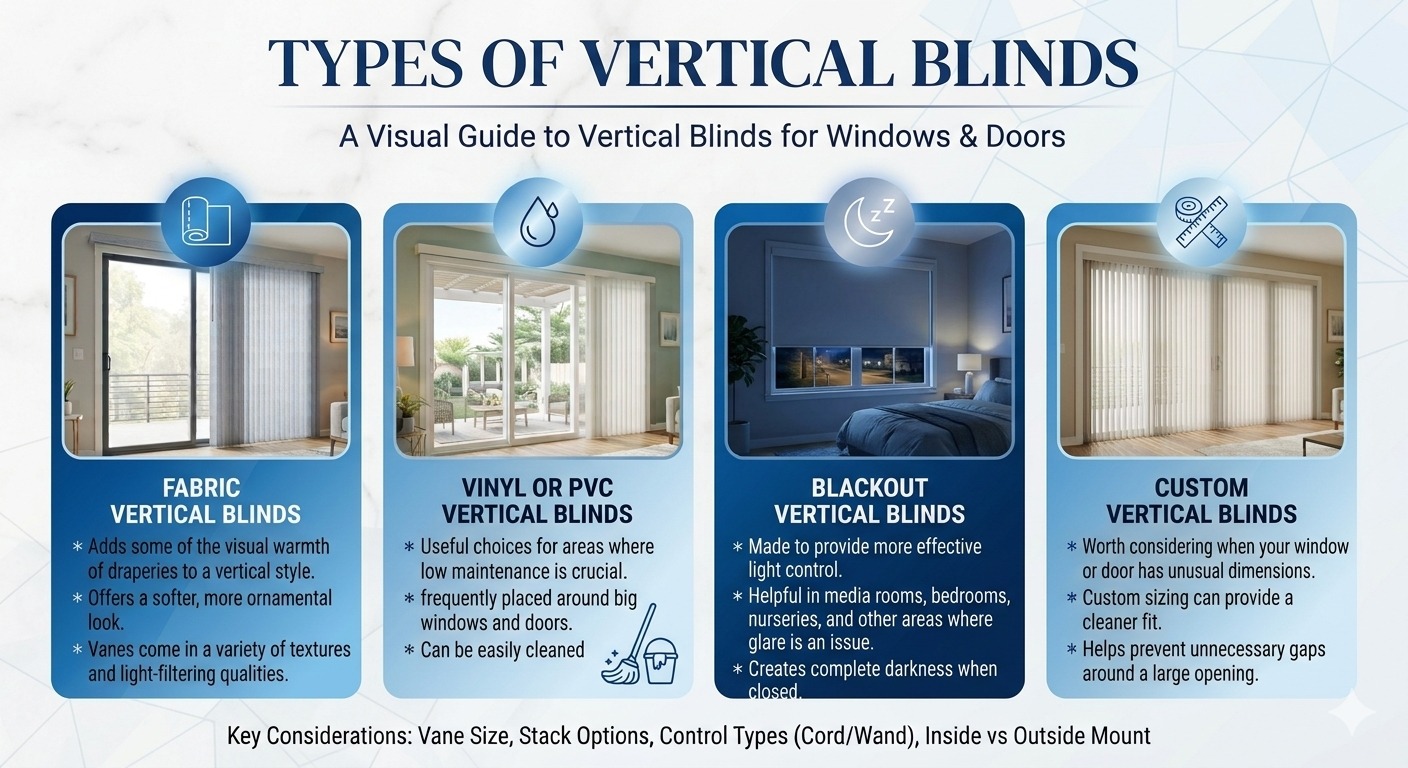
Fabric vertical blinds can add some of the visual warmth of draperies to a vertical style while also giving a softer, more ornamental look. Additionally, fabric vanes come in a variety of textures and light-filtering qualities.
Vinyl or PVC vertical blinds made of PVC or vinyl are useful choices for areas where low maintenance is crucial. They are frequently placed around big windows and doors and can be cleaned.
Blackout vertical blinds are made to provide more effective light control. They can be helpful in media rooms, bedrooms, nurseries, and other areas where glare is an issue.
Custom vertical blinds are worth considering when your window or door has unusual dimensions. Custom sizing can provide a cleaner fit and help prevent unnecessary gaps around a large opening.
How to Choose the Right Vertical Blinds
Start with the opening itself. A narrow standard window and a 10-foot sliding glass door will have very different requirements.
Consider these factors before ordering:
Width and height: Accurate measurements are essential for proper coverage.
Mounting position: Decide whether an inside or outside mount works better.
Material: Choose based on appearance, durability, and cleaning requirements.
Light control: Consider light filtering, room darkening, or blackout.
Opening direction: Think about where the vanes should stack when the blind is open.
Traffic flow: For sliding doors, make sure the stack position does not interfere with how you use the door.
Room style: Match the colour and texture with your existing furniture and finishes.
For wider spaces, a system should be considered that is meant to be used in large windows and sliding doors since it is likely that regular blinds would not fit. Contemporary vertical shades have been designed specifically for such instances.
How to Clean Vertical Blinds
Knowing how to clean vertical blinds properly helps prevent dust and grime from building up on the vanes.
Start with regular dry cleaning rather than immediately reaching for water. Close or align the vanes so you can clean them consistently, then use a soft microfiber cloth, feather duster, or vacuum cleaner with a brush attachment. Work from top to bottom and repeat on the opposite side.
For washable vinyl or PVC vanes, a mild soap solution and a soft sponge can be used when deeper cleaning is necessary. Avoid soaking fabric vanes unless the manufacturer's instructions specifically allow it.
A Simple Cleaning Routine
Remove loose dust with a soft brush or vacuum attachment.
Work gently from the top of each vane downward.
Spot-clean marks with an appropriate mild cleaning solution.
Avoid excessive moisture on fabric materials.
Allow cleaned vanes to dry properly.
Check the headrail and track for accumulated dust.
Always follow the care instructions supplied with your specific blind. Different materials can respond differently to moisture and cleaning products.
How to Install Vertical Blinds
If you're researching how to install vertical blinds, the process generally involves mounting the brackets, securing the headrail, attaching the vanes, and testing the operating mechanism.
Exact instructions vary between manufacturers, so the product-specific guide should always take priority. Standard installations generally follow these steps:
Measure and mark the mounting position. Make sure there is enough clearance for the vanes to rotate freely.
Install the brackets. Mark the bracket positions and secure them to the appropriate mounting surface.
Check alignment. Brackets should be level so the headrail operates properly.
Attach the headrail. Most systems hook or snap into the installed brackets.
Prepare the vane carriers. Rotate or position the carriers so they are ready to receive the vanes.
Attach each vane. Gently push each vane onto its corresponding carrier.
Install the valance if included.
Test the blind. Check both the rotation and side-to-side movement before regular use.
When it comes to installing wide blinds, it would be helpful to have someone assist you when mounting the headrail.
If you’re interested in blackout blinds and not vertical blinds, then you should refer to the installation guide for blackout blinds from the manufacturer.
Understanding Blackout Blinds
Blackout blinds are designed to reduce or eliminate incoming light, making them particularly useful where ordinary light-filtering window coverings aren't enough.
There are several types of blackout blinds, including:
Type | Best suited for | Main benefit |
Blackout roller blinds | Bedrooms and offices | Simple, clean appearance |
Blackout cellular shades | Large windows and doors | Light control plus insulation |
Blackout Roman shades | Living rooms and bedrooms | Softer decorative appearance |
Blackout vertical shades | Wide windows and sliding doors | Vertical operation across broad openings |
Custom blackout shades | Unusually sized windows | Precise fit and coverage |
One important thing to remember is that a blackout does not always imply that there is no light at all. Light can still pass through the gaps around the edges. The fit and edge coverage are as important as the cloth for optimal darkness.
Haven Shades provides a custom-fit blackout solution made around the precise window dimensions for customers comparing custom blackout blinds online. Dual-layer blackout fabric, an edge-seal system, cordless operation, and a custom-sized frame are all features of its Premium Blackout Haven Shade.
You can explore Haven Shades or view the Premium Blackout Haven Shade for product specifications.
The method of installation is also distinct from that of normal drill blinds. The instructions provided by Haven in the installation guide show how to mount the blind using the no-drilling tension method and using the provided parts.
FAQs
Are vertical blinds good for sliding doors?
Yes. Sliding door vertical blinds are quite convenient since the vanes slide sideways, allowing them to tuck away on either side, providing you access to the doorway once the blind is open.
Are vertical blinds good for large windows?
Yes. Vertical blinds are often employed for windows that are quite wide since the sliding mechanism of the vanes works well for large spaces. Custom sizes may come in handy where the standard size doesn’t work.
What are the best materials for vertical blinds?
The right material varies based on the room. While fabric works well if you want something that is more aesthetically pleasing, vinyl or PVC could work better for ease of cleaning and durability.
How often should I clean vertical blinds?
If the vertical blinds will be used regularly, then cleaning them a few times each month is a good strategy to adopt. Otherwise, they can be cleaned only after getting visibly dirty.
Can vertical blinds be custom made?
Yes, vertical blinds can be custom-made to fit certain windows or doors. They will be ideal for windows/doors whose sizes do not correspond to those of the standard sizes of vertical blinds.
Can I install vertical blinds myself?
There are many systems that can be self-installed if one has the right measurements, tools, and mounting surface. However, it is important to follow the manufacturer's installation instructions, as there are different brackets and screws for each system.
Subscribe to our Newsletter
Stay updated with sleep guides, bedroom decor inspiration, and exclusive product news.
Alex
Contributing writer and editor specializing in light control, bedroom aesthetics, and modern sleep science.


