Best Blackout Blinds for a Nursery: What Parents Should Look For
The best nursery blackout blinds are cordless, custom-fit and made to the exact window size. Here's how the main options compare on darkness, safety, and price.

Quick Answer
The best blackout blinds for nursery windows are cordless, custom-fit blinds made to the exact window size, like Haven Shades. Blackout fabric alone isn't enough, because most light sneaks in around the sides of a standard blind.
Best overall: Haven Shade, with an aluminum frame made to fit, dual-layer honeycomb fabric, and a tension mount that needs no drilling
Budget option: stock cordless blackout roller blinds, which block light through the fabric but leak at the edges
Extra layer: blackout curtains, which work best over a blind rather than on their own
Choose cordless to meet Health Canada's safety rules, and measure carefully for a close fit.
The Best Blackout Blinds for Nursery Windows at a Glance
If summer sunrises keep waking your little one long before you're ready, you already know why blackout blinds for nursery windows matter. Darker rooms support longer stretches of sleep, which we cover in do blackout blinds help babies sleep. The tricky part is that "blackout" on a label only describes the fabric. What actually keeps a room dark is how well the blind fits the window.
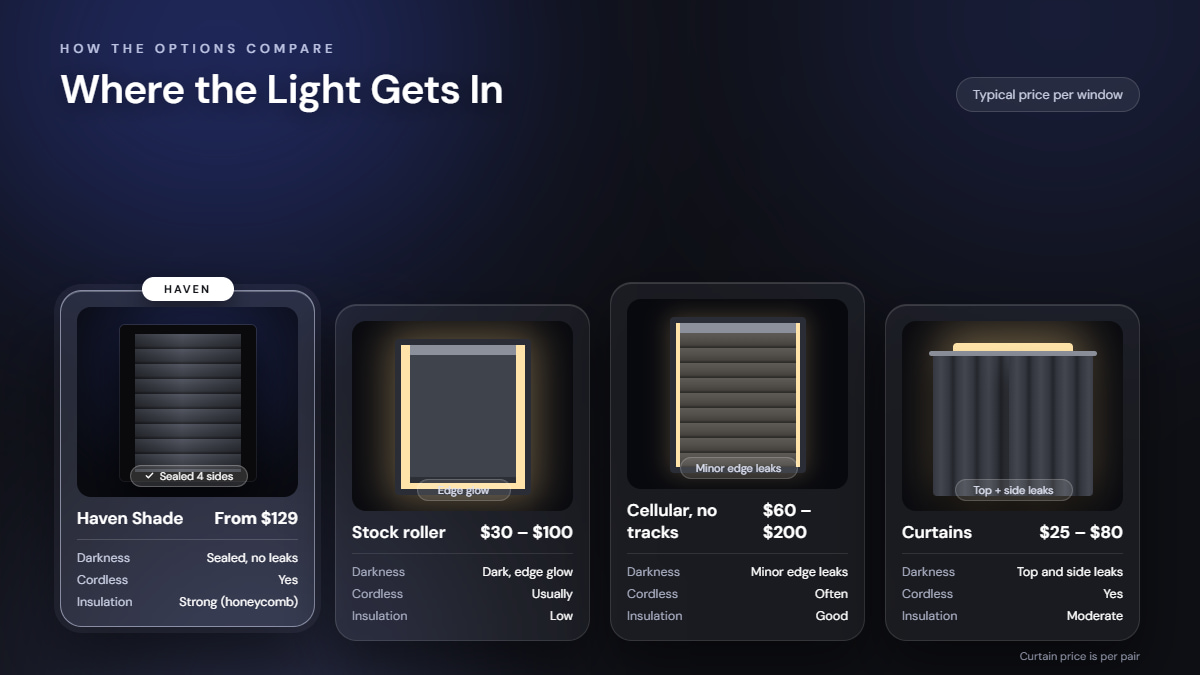
Here's how the Haven Shade compares with the other common options:
Option | Darkness level | Cordless | Insulation | Typical price per window |
|---|---|---|---|---|
Haven Shade | Very dark: made to fit the window | Yes | Strong (honeycomb) | From $129 |
Stock cordless blackout roller blind | Dark, with edge glow | Usually | Low | $30 to $100 |
Blackout cellular shade (no side tracks) | Dark, minor edge leaks | Often | Good | $60 to $200 |
Blackout curtains | Leaks at top and sides | Yes | Moderate | $25 to $80 per pair |
A close fit is what separates a dim room from a truly dark one, and it's why we make every Haven Shade to the exact window size.
Haven Shade (Our Top Pick)
If you want the best blackout blind for a nursery and only want to buy once, the Haven Shade is the one we recommend. It uses dual-layer, 100% blackout honeycomb fabric in an aluminum frame made to the exact size of your window.
Why it works so well in a nursery:
Total darkness for naps. A close fit cuts the glowing outline around the blind.
Cordless by design. No loops or dangling cords anywhere on the blind.
Temperature control. The honeycomb cells trap air, helping keep the room cooler in summer and warmer in winter.
A quieter room. The fabric absorbs some outside noise during daytime naps.
Made to measure. You pick both the fabric and frame colours to match the nursery.
It uses a tension mount, so you don't have to drill into your window frame, which is a big plus for renters. Our installation guide walks you through setup, and most windows take under 15 minutes. Every blind comes with a 2-year limited warranty, and our bundle offer takes 10% off two blinds and 15% off three or more if you're doing a nursery plus a sibling's room.
Best for: every nursery, especially east-facing rooms and babies who are light sleepers.
Other Blackout Solutions for Nursery Windows
Not every family needs a custom blind right away. Here's an honest look at the other options parents commonly consider.
Cordless Blackout Roller Blinds
Store-bought cordless blackout blinds in a roller style are the most common budget pick. The fabric blocks light well, but because the roll needs space to move, you'll get a strip of light down each side. Children's blackout roller blinds work fine for darker, north-facing rooms, but they struggle with direct morning sun.
Blackout Cellular Shades Without Side Tracks
These use the same honeycomb structure as our blinds, so they insulate well. Without side tracks, though, light still finds the edges. They're a solid middle ground for rooms where warmth matters more than total darkness.
Blackout Curtains
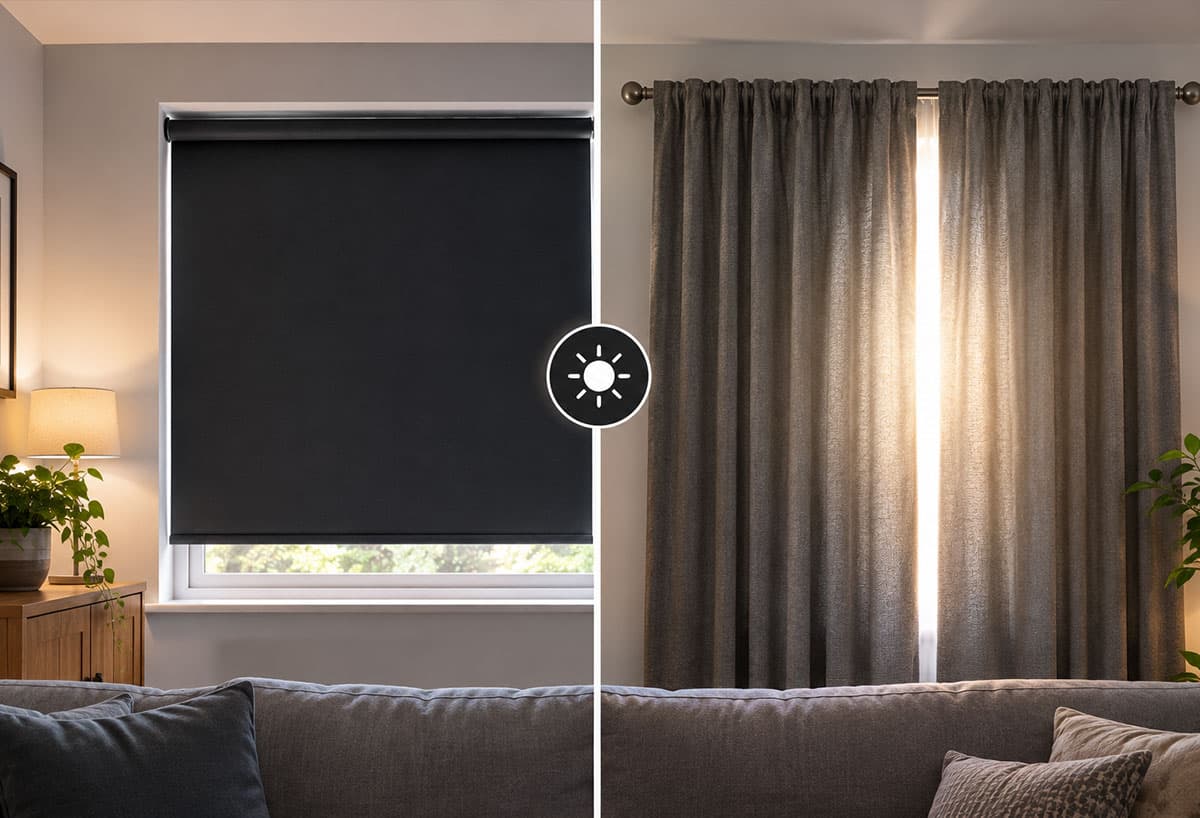
Curtains are easy to hang and cheap to replace, but they leak light over the rod and down the sides. They work best as a second layer over a blind rather than as your only blackout solution for a nursery. See our full comparison: are blackout curtains better than blinds.
Temporary Suction-Cup Blinds
Portable blackout sheets that stick to the glass are handy for travel or visits to the grandparents. They aren't designed for everyday nursery use because the edges peel over time, and kids can pull them down.
What Makes a Nursery Blackout Blind Safe
Safety comes before darkness every time. Window blind cords are a strangulation hazard for young children, and Health Canada has reported 39 child deaths in Canada linked to corded window coverings since 1989.
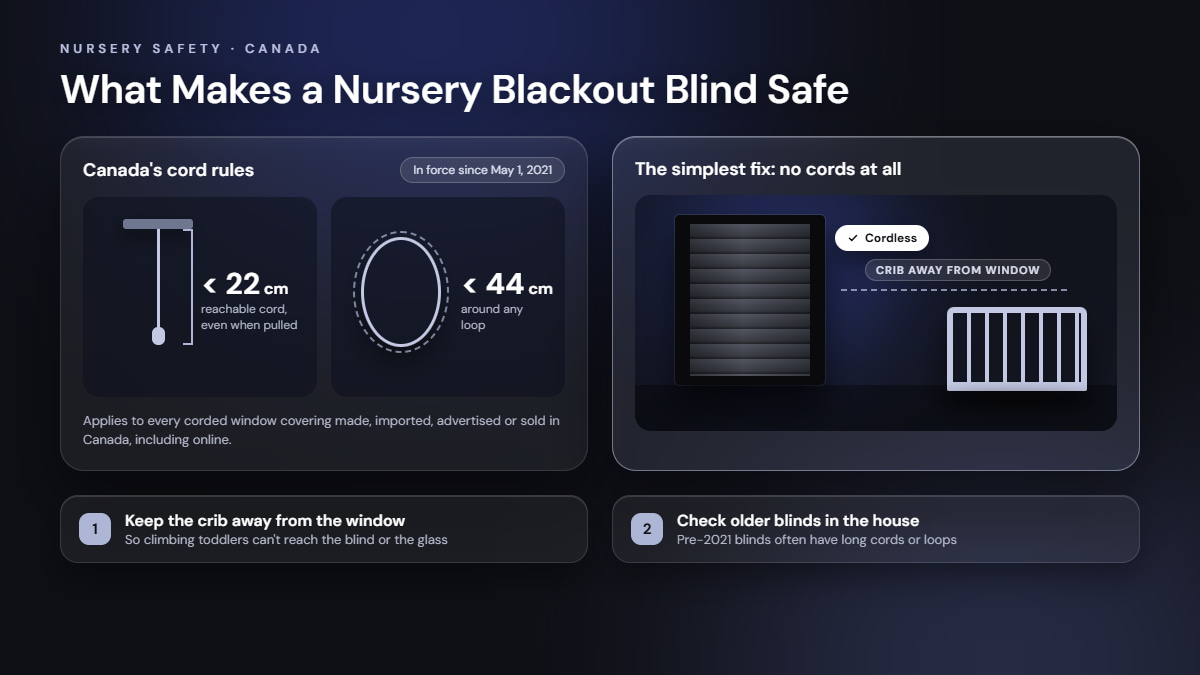
That's why Canada's Corded Window Coverings Regulations came into force on May 1, 2021. In plain terms, any cord a child can reach must stay shorter than 22 cm, even when pulled, and any loop must stay smaller than 44 cm around. The rules apply to every corded window covering made, imported, advertised, or sold in Canada, including online.
The simplest way to stay safe is to choose a blind with no cords. Even with a cordless blind, follow two habits we always recommend:
Keep the crib away from the window, so climbing toddlers can't reach the blind or the glass.
Check older blinds in the house. Hand-me-down or pre-2021 blinds often have long cords or loops that don't meet today's rules.
How to Get a Light-Tight Fit
Even the best blackout blinds only work if they fit properly. These are the most common fitting mistakes to avoid:
Measuring only once. Window frames are rarely perfectly square. Measure the width at the top, middle, and bottom, then use the smallest number. Our step-by-step measuring guide shows you exactly where to measure.
Ignoring what's in the frame. Window cranks, latches, and alarm sensors can stop a blind from sitting flush. Note them before you order.
Forgetting the sunrise. East-facing nurseries get direct light very early in summer. What looks like an insignificant crack at night becomes a bright line at dawn, so a close fit is crucial in these rooms.
In places with cold winters, like much of Canada, the honeycomb fabric does a second job. It helps hold warmth in on frosty nights, so the nursery stays cozy without cranking up the heat. If you're unsure how to measure an unusual window, talk to our team before you order.
For most families, the best blackout blinds for nursery windows come down to three things: cordless safety, 100% blackout fabric, and a precise fit. Get those right, and sunrise stops being your baby's alarm clock.
FAQs
What are the best blackout blinds for a nursery?
The best blackout blinds for nursery windows are cordless, custom-fit blinds made to the exact window size. Our Haven Shade is built exactly this way, with dual-layer, 100% blackout honeycomb fabric in an aluminum frame made to fit.
Are children's blackout roller blinds safe?
Cordless children's blackout roller blinds are safe when they're installed correctly and the crib is kept away from the window. Avoid any blind with reachable cords longer than 22 cm or loops bigger than 44 cm around, since those don't meet Health Canada's regulations.
Do blackout blinds for nursery windows create complete darkness?
Blackout blinds made to fit the window come closest; standard blackout blinds don't. Blackout fabric stops light passing through the material, while side tracks stop it coming in around the edges. You need both for a truly dark nursery.
Do blackout blinds in a children's room help with temperature control?
Yes, especially honeycomb designs. The air pockets in each cell slow heat moving through the window, which helps keep a nursery cooler in summer and warmer in winter.
How much do blackout blinds for a nursery cost?
Our Haven Shade starts at $129 per blind, with 10% off two blinds and 15% off three or more. Stock cordless roller blinds usually cost $30 to $100, but they leak light at the edges. The biggest price factors are window size, fabric, and whether the blind is custom-made. For a full breakdown, see how much do blackout blinds cost.
Subscribe to our Newsletter
Stay updated with sleep guides, bedroom decor inspiration, and exclusive product news.
Nick
Contributing writer and editor specializing in light control, bedroom aesthetics, and modern sleep science.