Common Mistakes When Buying Blackout Shades
Buying blackout shades isn't just about picking a dark fabric — small errors in measuring, mounting, or construction can leave you with a shade that still lets light through.

Table of Contents
AI Overview
Common Mistakes When Buying Blackout Shades
Confusing Blackout With Room Darkening
Assuming Blackout Fabric Means No Light Gaps
Measuring the Window Incorrectly
Choosing the Wrong Mounting Style
Ignoring the Shade's Construction
Choosing Based Only on Color or Appearance
Overlooking Installation Requirements
Not Comparing Different Blackout Options
How to Choose Blackout Shades
FAQs
At a Glance
Some errors people make when buying blackout shades are having the incorrect light blockage level, incorrect measurements, small light gaps, and an installation style that hasn’t been considered for your window. A blackout marking on the shades doesn’t ensure there will be no light visible, since there may still be gaps from which light can enter. You should consider the construction of the fabric, measurements, installation style, mounting, and fit before you purchase your blackout shades.
Common Mistakes When Buying Blackout Shades
Buying blackout shades isn't just about picking a dark fabric — small errors in measuring, mounting, or construction can leave you with a shade that still lets light through. Here are the most common mistakes to avoid before you order.
Confusing Blackout With Room Darkening
One of the first things that customers may get wrong about buying blackout shades is the misconception that room darkening and blackout are synonymous.
A room-darkening shade reduces the amount of light coming into the room, whereas a blackout shade blocks the passage of light through the material of the shade. When you want more darkness to sleep or watch television, it is best that you read the technical details of the product and not just pay attention to words like "darkening" or "light filtering".
This becomes especially true for people who are looking for blackout shades for their bedroom windows.
Assuming Blackout Fabric Means No Light Gaps
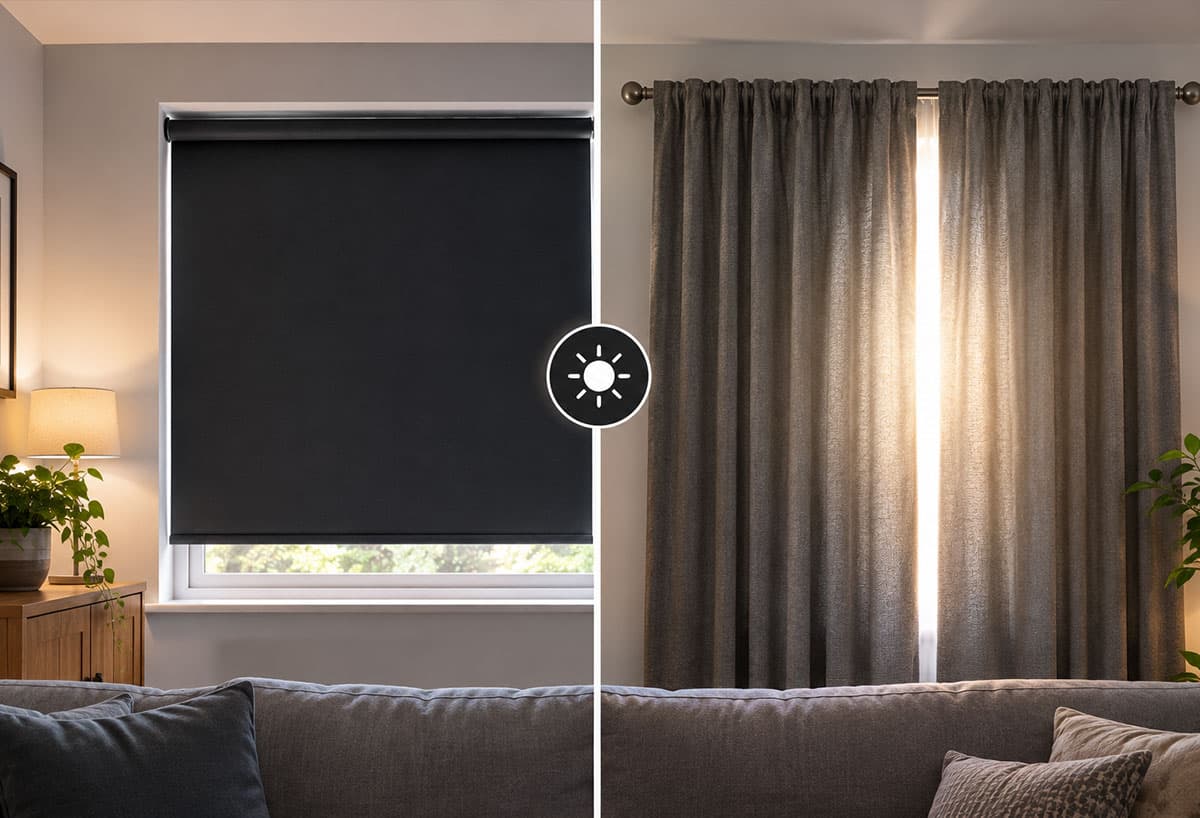
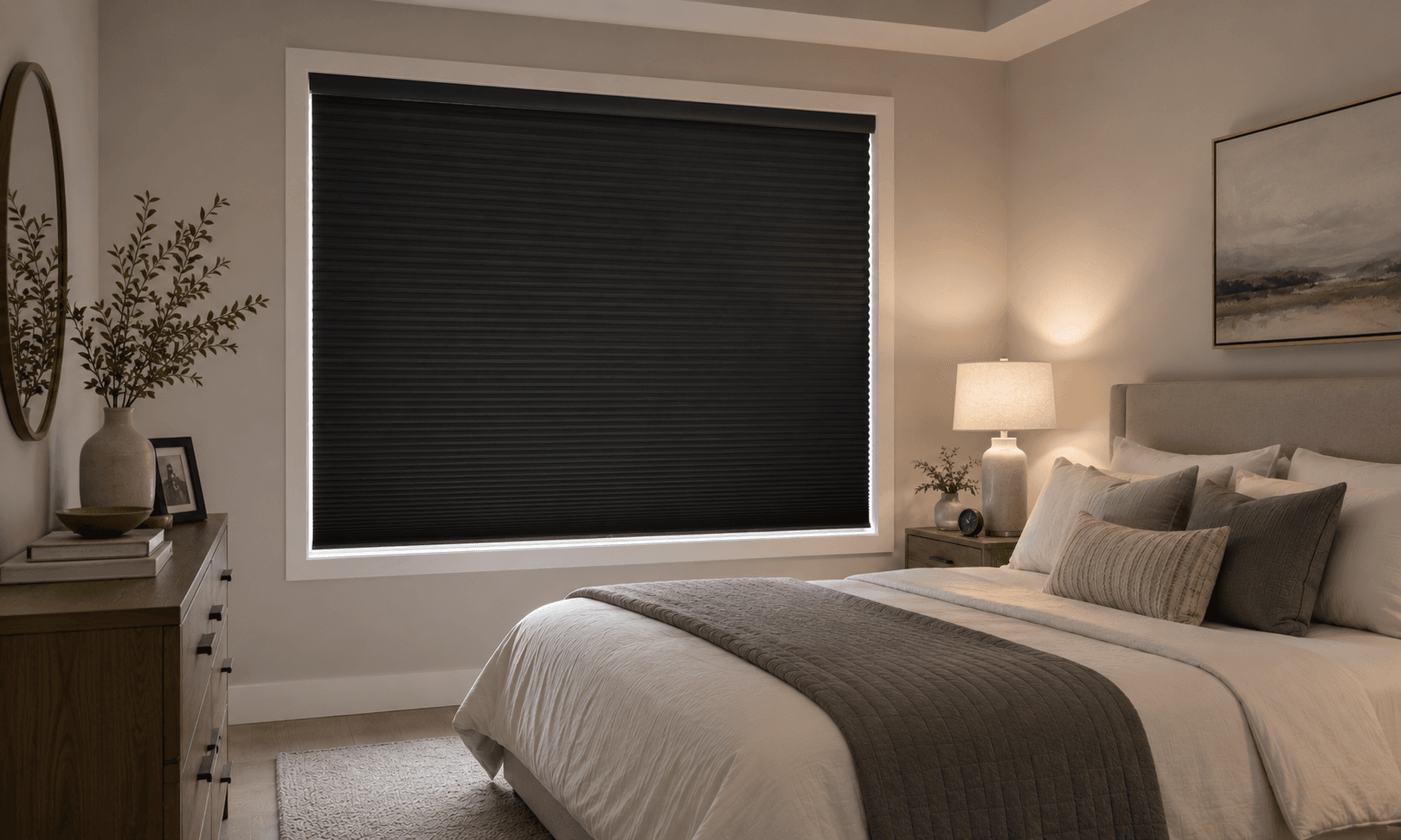
A blackout fabric can block light through the material while still allowing some light around its edges.
Inside-mounted shades typically need some operating clearance within the window recess. As a result, small gaps may appear along the sides. Outside mounting can extend the shade beyond the opening and reduce perimeter light.
When comparing blackout window shades, look at the complete design, not just the fabric's opacity.
What to Check | Why It Matters |
Fabric opacity | Determines how much light passes through the material |
Side coverage | Helps reduce light entering around the edges |
Top coverage | Can affect light entering above the shade |
Mounting style | Changes how closely the shade covers the window |
Frame or track | Can provide additional edge coverage |
Measuring the Window Incorrectly
Incorrect measurements are among the easiest blackout shades mistakes to avoid.
Don't measure a window and then place an order right away. From one location to another, window openings can differ slightly. These variations may have an impact on the final fit of bespoke shades.
A more effective method is to:
Take measurements of the top, middle, and bottom widths.
Take height measurements on the left, center, and right.
Take close note of the measurements.
For the particular mount, adhere to the manufacturer's instructions.
When necessary, check the depth of the window recess.
For its custom-fit system, Haven Shades, for instance, asks consumers to measure height at three locations and width at three points, using the smallest readings.
Unless instructed otherwise by the manufacturer, do not automatically add or subtract measurements. Measurement guidelines vary depending on the product.
Choosing the Wrong Mounting Style
The functions of inside and outside mounts are distinct.
The inside mount keeps the shade within the window recess to give a clean, built-in look. But sometimes, there will be spaces at the edges of the shade that allow light into the room.
The outside mount allows more coverage around the window. This is beneficial especially if reducing light leakage is very important.
Before deciding, consider:
Available recess depth
Window handles or locks
Trim around the window
Desired appearance
How much edge light you can tolerate
The best choice depends on both your window and your darkness requirements.
Ignoring the Shade's Construction
Not all blackout blinds use the same construction.
Some employ enclosed systems or layered fabrics to minimise light transmission and perimeter gaps, while others rely on an opaque backing or liner.
For this reason, evaluating a product's construction is more beneficial than determining a shade only by its thickness. Find out how the product manages light around the edges and what causes the material to black out.
For instance, Haven Shades states that its Premium Blackout Haven Shade uses a unique aluminium frame and dual-layer thermal fabric with an edge-seal mechanism.
Choosing Based Only on Color or Appearance
A common misconception is that a darker shade will automatically provide better blackout performance.
The surface color is not necessarily what determines whether light passes through the fabric. The backing, inner layer, and overall construction play a more important role.
So when choosing blackout shades for windows, consider appearance alongside:
Light-blocking construction
Privacy
Fit
Maintenance
Operating mechanism
Installation requirements
This gives you a better balance between design and function.
Overlooking Installation Requirements
The performance may be impacted if the correct shade is purchased but installed improperly.
Verify whether the product needs drilling, a particular mounting depth, extra hardware, or expert installation before placing your order.
Haven Shades offers a specific installation guide that explains how to install blackout shades. The current guide offers detailed directions for fitting the shade along with a list of the parts that come with the device.
Read the installation instructions before purchasing if you're thinking of getting custom blackout blinds online, rather than waiting for the item to arrive.
Not Comparing Different Blackout Options
Another common mistake that people make is believing that all blackout blinds operate the same way.
Depending on the particular window and the room, there can be multiple types of blackout blinds which include roller, cellular, roman, and framed blinds. Different types of blinds have varying designs, aesthetics, operating mechanisms, and techniques of managing light leaks.
For instance, a regular fabric curtain may be the best choice for a room where aesthetics is key, whereas a framed blackout blind is better suited when minimizing light gaps is critical.
How to Choose Blackout Shades?
A practical blackout shade buying guide should begin with your actual requirements rather than the product's appearance.
Before ordering, ask:
How dark does the room need to be?
Is the shade intended for a bedroom, nursery, office, or media room?
Should it be inside or outside mounted?
Have the window measurements been checked at multiple points?
Does the window have handles, locks, or other obstructions?
How is the shade designed to manage edge light?
What installation method does the product require?
Can the shade be custom sized?
Haven Shades offers custom sizing, with measurements taken at multiple points to create a fitted system. Its Premium Blackout Haven Shade also combines a dual-layer fabric with an edge-seal design.
If you're comparing custom blackout blinds online, you can review the Haven Shades collection or explore the Premium Blackout Haven Shade before making a decision.
FAQs
What are the most common mistakes when buying blackout shades?
Some of the errors that people tend to make include confusion between blackout and room darkening shades, incorrect measurements, light leakage, incorrect mounting types, and installation requirements.
How do I choose blackout shades?
Consider the amount of darkness you would like, window size, mounting of the blind, type of material used, edging, installation, and fit. In case of customized products, always take note of the measurements provided by the manufacturer.
Do blackout shades block all light?
Blackout fabric prevents light from passing through, although light can come through the cracks around the shade. Thus, the whole installation process is crucial.
Are blackout shades good for bedrooms?
Yes. Blackout shades for bedroom windows allow you to reduce exposure to light and enhance visibility at night time. They are very effective if you want a high level of light control.
What should I check before installing blackout blinds?
Check the measurements, mounting surface, window depth, hardware clearance, and product-specific installation instructions. Haven Shades provides a dedicated installation guide for its blackout system.
Subscribe to our Newsletter
Stay updated with sleep guides, bedroom decor inspiration, and exclusive product news.
Anna
Contributing writer and editor specializing in light control, bedroom aesthetics, and modern sleep science.